
Technical screen
320 questionsOne coding problem, 45 minutes, live narration expected.
v3.0 — The Developer Learning Operating System
Documentation, interactive labs, DSA playground, algorithm visualizers, MCQ rounds and company-specific interview prep — unified into one continuous system instead of scattered tabs.
1// twoSum.ts · O(n) Time · O(n) Space2export function twoSum(nums: number[], target: number) {3 const seen = new Map<number, number>();4 for (let i = 0; i < nums.length; i++) {5 const need = target - nums[i];6 if (seen.has(need)) return [seen.get(need)!, i];7 seen.set(nums[i], i);8 }9}Stop context-switching between docs, YouTube tabs and disjointed sandboxes. Everything a developer needs to learn, practice, prepare and grow lives in one continuous environment.
From the first line of a visualizer to the final mock interview, your progress is tracked inside a single persistent XP ecosystem.
Read in-depth guides with inline runnable code, architecture diagrams & ⌘K search.
01What we have
Every part of the platform hands off to the next one. Read a concept, practice it in a lab, watch it run, drill it in a quiz, then defend it in a mock interview round.
Depth-first written guides, not video transcripts.
Reading is faster than watching when you already know 60% of a topic.
A real editor and test suite inside every lesson.
Concepts stick when the suite goes green with your code.
Curated problems with hints, editorials and submissions.
Pattern coverage beats random problem grinding.
Frame-by-frame animation with the matching pseudocode line.
You cannot debug what you cannot picture.
Question banks per round: coding, design, behavioral.
Rehearsal removes the surprise from the real loop.
Timed rapid-fire rounds with instant explanations.
Screening rounds are won on fundamentals under a clock.
Week-by-week plans that chain every surface together.
A finite path beats an infinite content library.
Banks tuned to how each company actually interviews.
Google's bar is not Stripe's bar.
Topic-level readiness, not a vanity completion bar.
Identify exact weaknesses before entering real loops.
Every solved case, lab and quiz earns weighted XP.
Gamified retention backed by persistent telemetry.
One problem a day keeps the plan alive.
Daily momentum compounds over 18-week roadmaps.
02Documentation
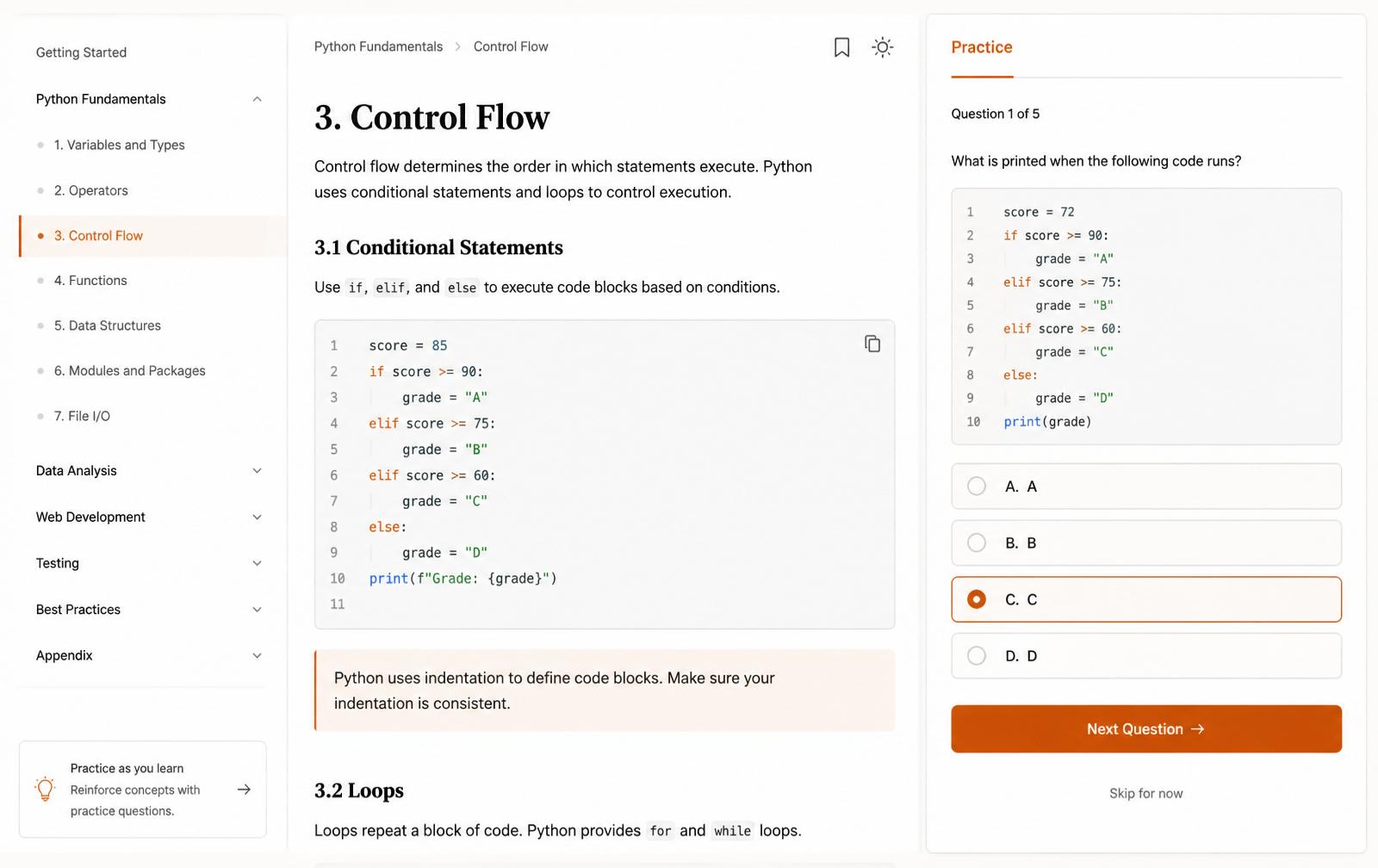
Explorer, folder tree, breadcrumbs, Mermaid diagrams, runnable snippets, tabbed examples and per-page progress. Everything is searchable with ⌘K and remembers where you left off.
docsjavascriptcontrol-flow
An await inside a loop serialises work on purpose. Reach for it when order matters — and for Promise.all when it doesn't.
1for (const task of queue) {2 await run(task); // sequential execution by design3}Maintained by senior staff engineers who interview candidates at top tech companies.
 JavaScript
 React
React Angular
 Node.js
 Python
 SQL
SQL MongoDB
 Git
Git03Interactive programming labs
Every lesson ends in a lab: a scoped file tree, a real editor, a test suite and an execution sandbox. You submit only when the suite is green — and the XP lands the moment it is.
1// Lab 07 — debounce() implementation2export function debounce(fn, wait = 300) {3 let timerId;4 return (...args) => {5 clearTimeout(timerId);6 timerId = setTimeout(() => fn(...args), wait);7 };8}Integrated VS Code engine with autocomplete, linting and real keybindings.
Stream stdout, stderr, exception tracebacks and process exit codes.
Interactive UI components render dynamically right beside your code.
Visible & hidden test suites execute automatically on every save (⌘S).
Code drafts survive browser refreshes, tab switching, and crash recovery.
Toggle split view, font sizes and full-screen focus for distraction-free coding.
04DSA playground
Filter by difficulty, company or pattern. Every problem ships with constraints, staged hints, an editorial, four language runtimes, submission history and a complexity report on each run.
| Problem | Level | Accepted | Companies |
|---|---|---|---|
Two Sum Array · Hash Map | Easy | 94.2% | Google · Amazon |
Longest Substring Without Repeat Sliding Window · String | Medium | 38.7% | Meta · Uber |
Course Schedule Graph · Topo Sort | Medium | 46.1% | Microsoft · Stripe |
Merge k Sorted Lists Heap · Linked List | Hard | 51.4% | Amazon · Netflix |
Word Ladder BFS · Graph | Hard | 37.9% | Google · Adobe |
126 days of telemetry. Consistency compounds over time.
68
Easy solved
54
Medium solved
19
Hard solved
> input:    nums = [2,7,11,15], target = 9
> output:   [0,1]
> time:     O(N)
> space:    O(N)
✓ Verified · 41ms · 44.2MB
05Algorithm visualizers
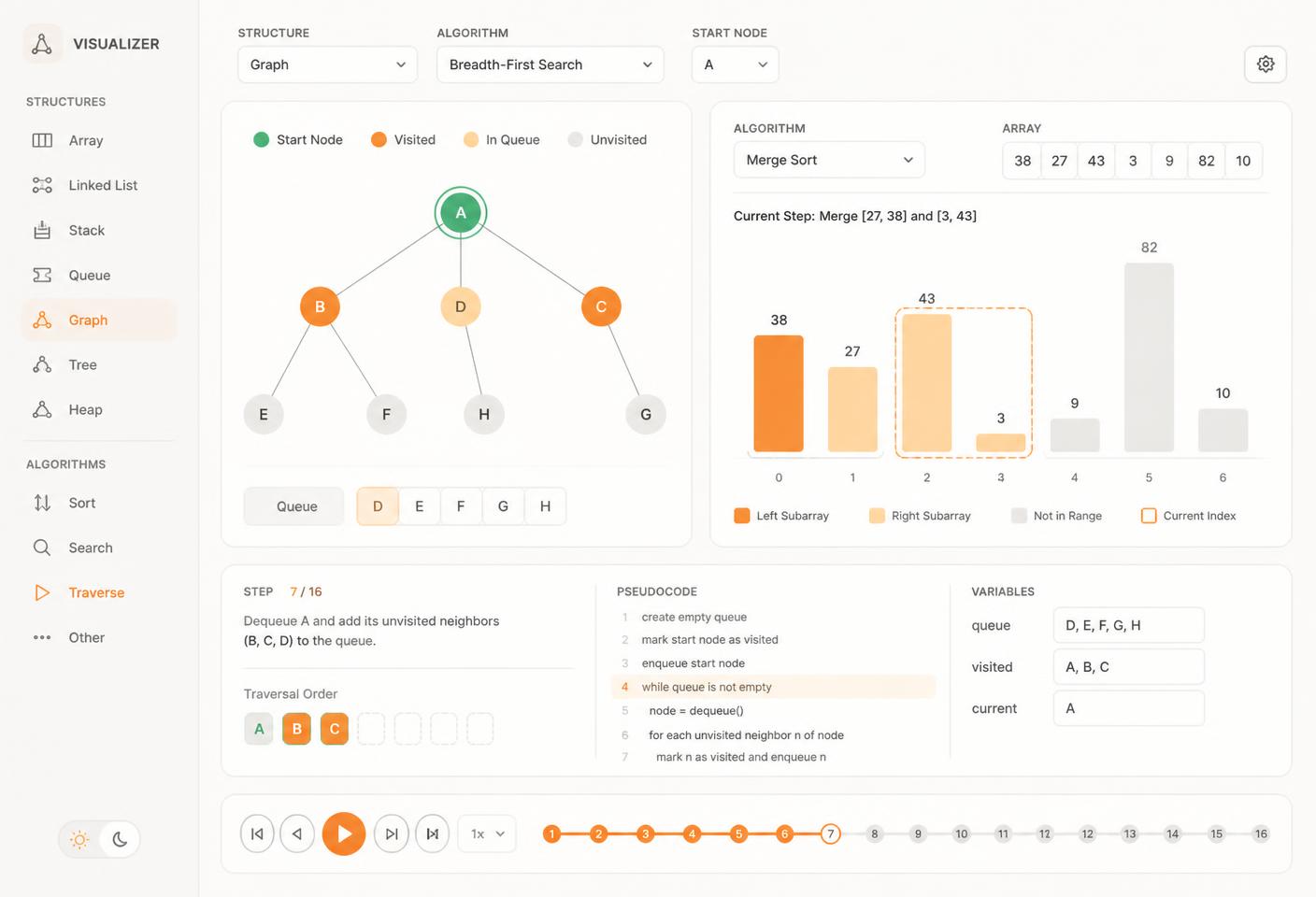
Scrub, step, replay and race algorithms side by side. Every frame highlights the matching pseudocode line and the live state of your queue, stack or pointer window.
queue   → [E, F]
visited → {A, B, C, D}
depth → 2Select an algorithm to watch real-time partitioning, comparisons, and memory pointer shifts.
Compare algorithm time complexities to see why O(N log N) sorts beat O(N²) quadratic algorithms when dataset N reaches 10,000+.
06Interview preparation
Filter by stack, difficulty and company. Each question ships with a model answer, the follow-up chain, a cheat sheet and a readiness score that updates as you rehearse.
Core Evaluation Focus
Interviewers assess structured thinking, edge case awareness, and clear narration under pressure.
One coding problem, 45 minutes, live narration expected.
HLD and LLD prompts with reference architectures and trade-off tables.
STAR-structured answers with the follow-ups interviewers actually ask.
Scope, ownership and impact questions, mapped to each level.
Mock interviews run on a timer with an automated panel debrief.
07MCQ hub
Sixty seconds a question. Instant explanation, XP on correct answers, a review-later queue for everything you fumbled, and a weekly leaderboard if you like the pressure.
Explanation & Context
The queue is drained to empty after each macrotask completes and before the next render — which is why promise chains can starve timers.
87%
Round accuracy · 13 of 15 correct
08Guided learning roadmaps
Every track chains the same eight stops. Clear, structured guidance from your first lesson to final track mastery.
From semantic HTML and the event loop through React 19 concurrent patterns, performance budgets, WebGL rendering, and web accessibility.
Deep-first concept guides and interactive reference sheets.
Write code in a real Monaco editor with automated test suites.
Drill pattern-based algorithm problems until it becomes muscle memory.
Watch state changes frame-by-frame with matching pseudocode lines.
Prove recall under a 60-second timer before live interviews.
Technical screens, system design loops, STAR stories & rubrics.
Ship a real application that withstands code review.
Verified track completion, ready to interview at top tech companies.
09Company preparation
Not a logo wall. Select a company and the bank rewrites itself — its real problem set, the questions its panels ask, the design prompts it favours, your progress and the acceptance rate you're tracking against.
loop structure
5 rounds · 2 coding, 1 design, 1 behavioral, 1 googleyness
most asked problems
difficulty · Hard
02The product
Not screenshots side by side — the real surfaces, layered the way they stack in use: the editor behind, the console, the tests and the reward floating over it.
documentation
Open a concept and the whole reading environment assembles: the tree on the left, command search over the top, the architecture diagram inline and an assistant that answers from the page you're on.
<ul>
  {items.map(i => (
    <Row key={i.id} {...i} />
  ))}
</ul>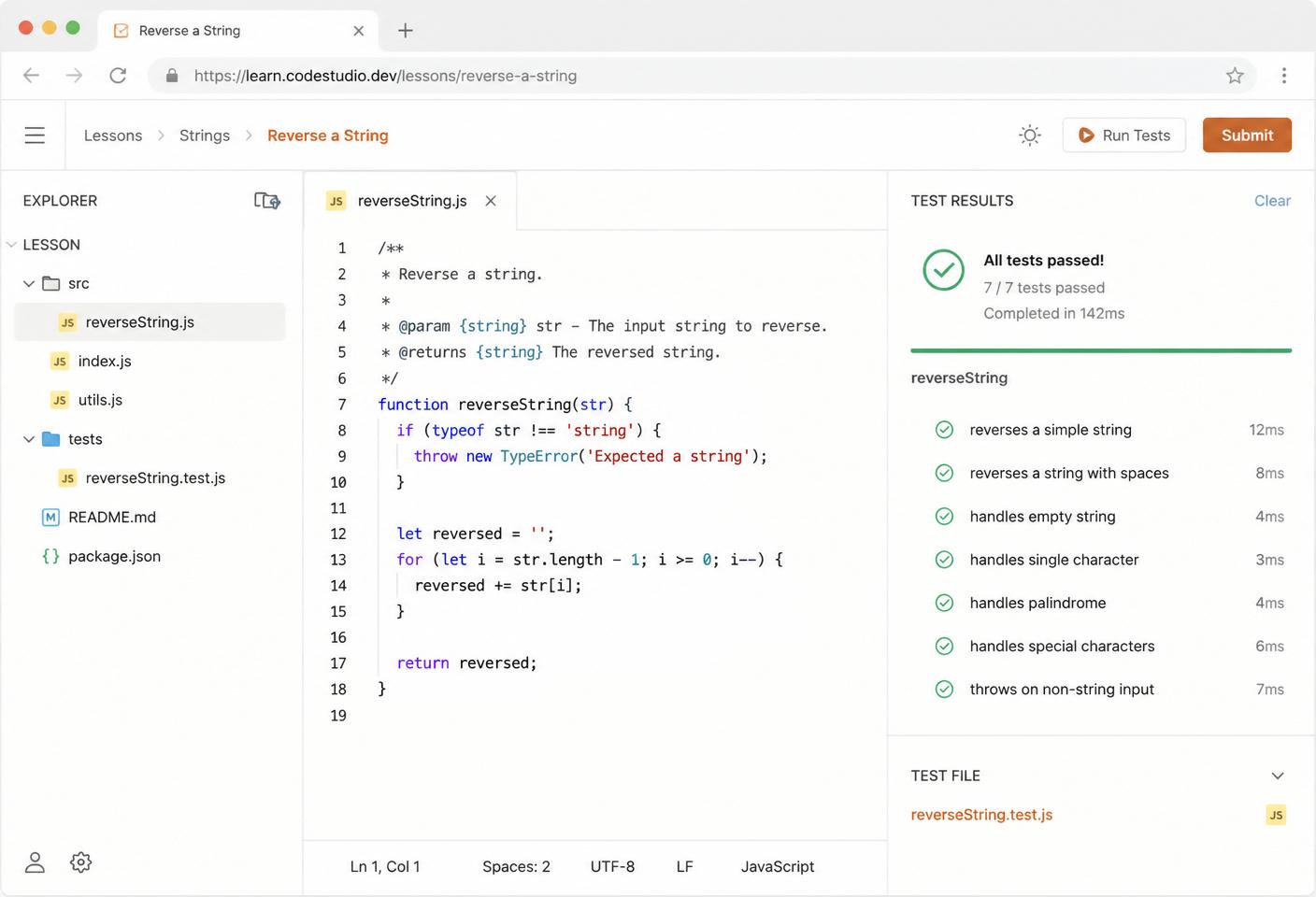
xp earned
+120
programming labs
Editor, console, tests, verdict and reward stack in one frame — the whole loop fits on a 13-inch screen without a single collapsed panel.
10Progress & XP
XP, levels, streaks and goals exist for exactly one reason: to make the next session easier to start. Honest picture of readiness with real execution telemetry.
0
XP Earned · Level 7
0 Days
Active Streak · Best 31
0
Badges Unlocked
6 / 7
Weekly Goal Sessions
11Community & achievements
Discussion threads on every problem, peer solution reviews, weekly cohort rounds and verifiable certificates when a track is finished.
Solved every graph problem in the core curriculum.
A full month without breaking daily learning goals.
Read official staff editorials after 50 accepted runs.
Cleared five timed mock interview panels with green scores.
Reading, solving, and reviewing code every month.
Alternative solutions, edge-case debates, and follow-ups.
Docs and problem sets continuously refined for interview prep.
16Questions
The things engineers ask before they start — what the platform covers, how to sequence your preparation, and what actually shows up in interviews.
Interview Prep Buddy is a free, all-in-one technical interview preparation platform for software engineers. It combines DSA pattern cheatsheets, interactive algorithm visualizers, browser-based coding labs, 1400+ interview questions, MCQ practice rounds, and system design guides — so you prepare in one place instead of across a dozen scattered tabs.
Work in four passes. First, learn the 16 core DSA patterns (two pointers, sliding window, binary search, BFS/DFS, dynamic programming, backtracking) rather than memorising individual problems. Second, drill problems by pattern until you can recognise which one a new question needs. Third, study system design fundamentals — caching, sharding, queues, consistency trade-offs. Fourth, review language-specific questions for your stack and rehearse behavioural answers with the STAR method.
Yes. Every algorithm visualizer on Interview Prep Buddy is free and needs no sign-up or payment. That covers sorting, searching, arrays, linked lists, stacks, queues, hash tables, heaps, trees, graphs, recursion, backtracking, dynamic programming, two pointers, and sliding window — each with step-by-step animations, synchronized pseudocode highlighting, and Big-O complexity panels.
Arrays and strings, hash maps, two pointers, sliding window, binary search, trees and binary search trees, graphs (BFS, DFS, topological sort), heaps, and dynamic programming account for the large majority of questions at Google, Amazon, Meta, Microsoft, and Apple. Recursion and backtracking appear regularly at the harder end. Bit manipulation and tries show up less often but are worth a pass before onsites.
With consistent daily practice, most engineers need roughly 8 to 12 weeks: about 4 weeks to cover the core DSA patterns, 4 weeks of mixed problem drilling under time pressure, and 2 to 4 weeks on system design and behavioural rounds. If you already write code professionally and just need a refresher, a focused 4 to 6 week pass on patterns and mock problems is usually enough.
High-level design (HLD) asks you to architect a whole system — choosing databases, caches, queues, and service boundaries, then reasoning about scale, availability, and consistency trade-offs. Low-level design (LLD) narrows to one component and tests object-oriented modelling: classes, interfaces, relationships, and design patterns. HLD rounds reward breadth and trade-off reasoning; LLD rounds reward clean, extensible class design.
It's an entire developer operating system. Free to start — no credit card, no drip-fed course emails. Just the real docs, Monaco labs, algorithm visualizers, and the loop.