
Pattern 1 — Classic Binary Search
Pattern 1 — Classic Binary Search
Section titled “Pattern 1 — Classic Binary Search”🎯 When to Use
Section titled “🎯 When to Use”Find a specific value in a sorted array. Return its index or -1.
Sorted: [2, 5, 8, 12, 16, 23, 38, 56, 72, 91]Target: 23Output: 5🧠 The Template
Section titled “🧠 The Template”function classicBinarySearch(arr, target) { let lo = 0; let hi = arr.length - 1;
while (lo <= hi) { const mid = lo + Math.floor((hi - lo) / 2);
if (arr[mid] === target) return mid; // exact match if (arr[mid] < target) lo = mid + 1; // go right else hi = mid - 1; // go left }
return -1; // not found}🔑 Key Decisions Explained
Section titled “🔑 Key Decisions Explained”Decision 1: lo <= hi not lo < hi
Section titled “Decision 1: lo <= hi not lo < hi”| Condition | Meaning | When to Use |
|---|---|---|
lo <= hi | Stop when search space is empty | ✅ Classic search — need to check every element |
lo < hi | Stop when one element remains | Pattern 5 — Boundary search |
With lo <= hi, when lo === hi, there is 1 element left to check. The loop will run one more time and either find the target or (if not found) set lo > hi which exits the loop.
Decision 2: lo = mid + 1 and hi = mid - 1
Section titled “Decision 2: lo = mid + 1 and hi = mid - 1”Since arr[mid] !== target, we can safely exclude mid from the new search space.
❌ lo = mid → if lo === mid, infinite loop!✅ lo = mid + 1 → always makes progressDecision 3: Safe Midpoint Calculation
Section titled “Decision 3: Safe Midpoint Calculation”// ❌ Can overflow (Java/C++ with large arrays)const mid = Math.floor((lo + hi) / 2);
// ✅ Safe — mathematically identicalconst mid = lo + Math.floor((hi - lo) / 2);In JavaScript (64-bit floats), overflow is unlikely, but using the safe form is a good interview habit that interviewers notice.
💻 Complete Walkthrough
Section titled “💻 Complete Walkthrough”Search for target = 35 in: [5, 10, 15, 20, 25, 30, 35, 40, 45]
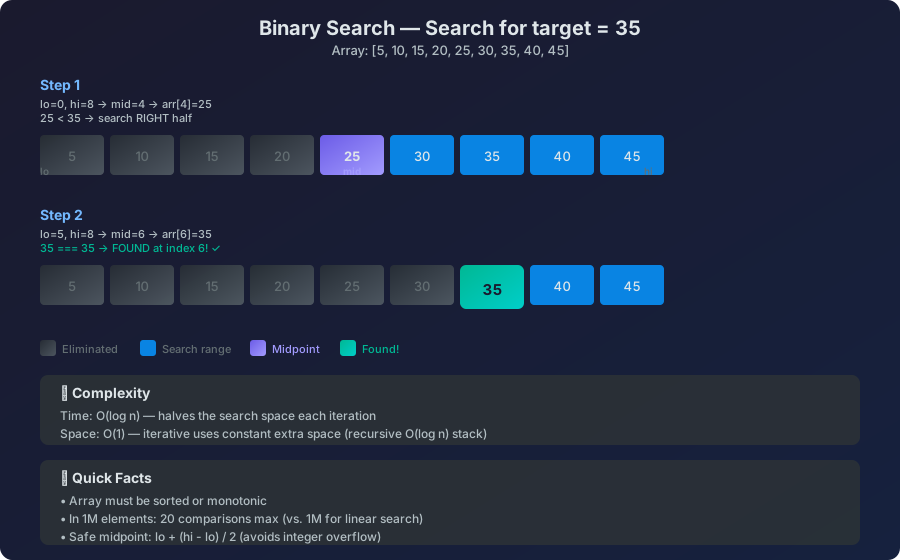
Step-by-Step
Section titled “Step-by-Step”Array: [5, 10, 15, 20, 25, 30, 35, 40, 45]Index: 0 1 2 3 4 5 6 7 8
Step 1: lo=0, hi=8, mid=(0+8)/2=4 → arr[4]=25 25 < 35 → target is RIGHT → lo = mid+1 = 5
Step 2: lo=5, hi=8, mid=(5+8)/2=6 → arr[6]=35 35 === 35 → FOUND at index 6! ✓Only 2 comparisons out of 9 elements. For 1M elements, at most 20 comparisons.
📊 Complexity
Section titled “📊 Complexity”| Metric | Value |
|---|---|
| Time | O(log n) — halves the search space each iteration |
| Space | O(1) — iterative (recursive uses O(log n) call stack) |
Why O(log n)?
n elements  → After step 1: n/2 remain            → After step 2: n/4 remain            → After step k: n/2^k remain
Stop when n/2^k = 1 → k = log₂(n)| n | log₂(n) |
|---|---|
| 10 | ~3 |
| 1,000 | ~10 |
| 1,000,000 | ~20 |
| 1,000,000,000 | ~30 |
🧪 Test It
Section titled “🧪 Test It”const arr = [5, 10, 15, 20, 25, 30, 35, 40, 45];console.log(classicBinarySearch(arr, 35)); // 6console.log(classicBinarySearch(arr, 99)); // -1console.log(classicBinarySearch(arr, 5)); // 0 (first element)console.log(classicBinarySearch(arr, 45)); // 8 (last element)console.log(classicBinarySearch([], 1)); // -1 (empty array)🐛 Off-By-One Pitfalls
Section titled “🐛 Off-By-One Pitfalls”See the detailed Off-By-One Pitfalls visual guide.
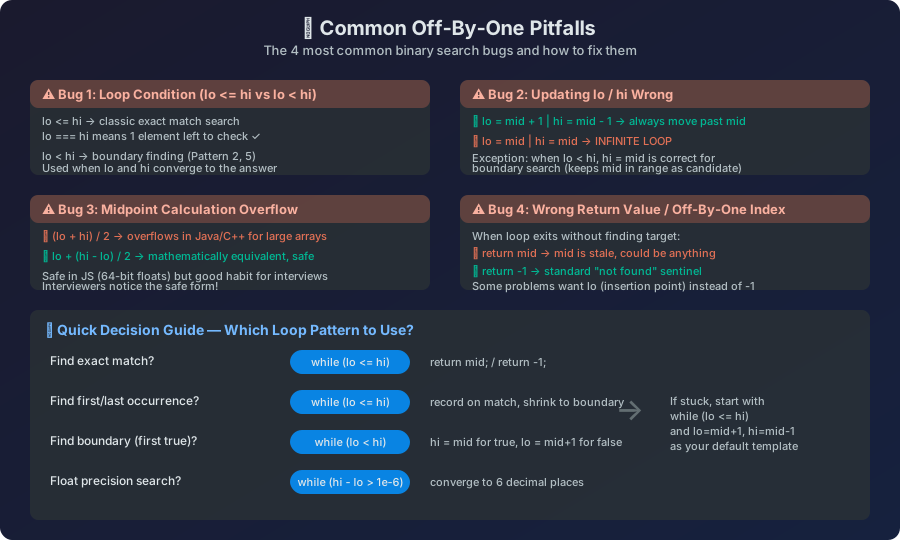
| Bug | Mistake | Fix |
|---|---|---|
| Wrong loop condition | while (lo < hi) | Use while (lo <= hi) for classic search |
| Not moving past mid | lo = mid | Use lo = mid + 1 and hi = mid - 1 |
| Wrong return | return mid after loop | return -1 when not found |
| Overflow | (lo + hi) / 2 | Use lo + (hi - lo) / 2 |