
Types of Recursion
Types of Recursion
Section titled “Types of Recursion”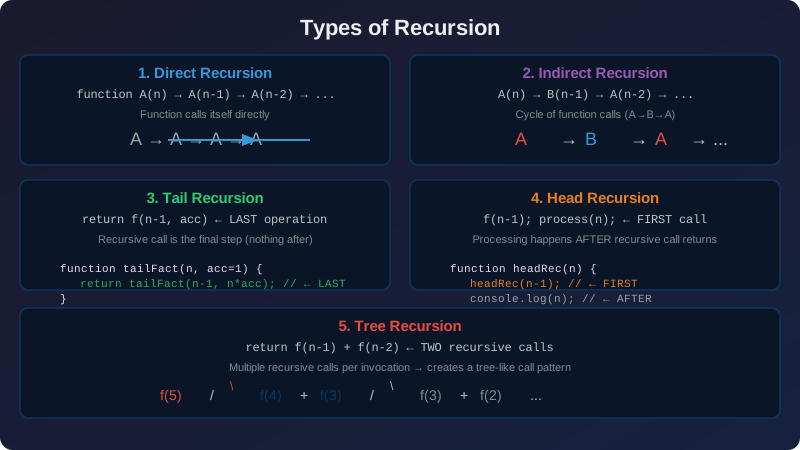
Direct Recursion
Section titled “Direct Recursion”A function calls itself directly.
// Direct recursion: functionA → functionA → functionA → ...function functionA(n) { if (n <= 0) return; console.log(n); functionA(n - 1); // ← calls ITSELF}Indirect Recursion
Section titled “Indirect Recursion”Function A calls Function B, which calls Function A (a cycle of calls).
// Indirect recursion: functionA → functionB → functionA → ...function functionA(n) {    if (n <= 0) return;    console.log("A:", n);    functionB(n - 1);  // ← calls B}
function functionB(n) {    if (n <= 0) return;    console.log("B:", n);    functionA(n - 1);  // ← calls A}
functionA(5);// Output: A:5, B:4, A:3, B:2, A:1
Visualization: functionA(5) → functionB(4) → functionA(3) → functionB(2) → functionA(1) → STOPTail Recursion
Section titled “Tail Recursion”The recursive call is the LAST thing the function does. There’s nothing to do after the recursive call returns.
// ✅ TAIL RECURSIVE — recursive call is the LAST operationfunction tailFactorial(n, accumulator = 1) {    if (n <= 1) return accumulator;    return tailFactorial(n - 1, n * accumulator);  // ← LAST thing. Nothing after this.}
// ❌ NOT TAIL RECURSIVE — still need to multiply AFTER the recursive call returnsfunction factorial(n) {    if (n <= 1) return 1;    return n * factorial(n - 1);  // ← Must multiply n AFTER factorial(n-1) returns}
Why does tail recursion matter?
Some languages/compilers optimize tail recursion into a loop (called Tail Call Optimization / TCO), so it uses O(1) stack space instead of O(n). JavaScript technically supports TCO in strict mode (ES6), but in practice, most engines (V8/Chrome, Node.js) do NOT implement it.
Non-tail factorial(4):                      Tail tailFactorial(4, 1):
factorial(4)                                tailFactorial(4, 1)  4 * factorial(3)                          tailFactorial(3, 4)    3 * factorial(2)                        tailFactorial(2, 12)      2 * factorial(1)                      tailFactorial(1, 24)        returns 1                           returns 24  ← direct answer!      returns 2*1 = 2    returns 3*2 = 6  returns 4*6 = 24
Stack depth: O(n)                           Stack depth: O(n) without TCO                                            Stack depth: O(1) with TCO ✨
Head Recursion
Section titled “Head Recursion”The recursive call is the FIRST thing the function does. All processing happens after the recursive call returns.
// HEAD RECURSION — recursive call is FIRST, processing happens AFTERfunction headRecursion(n) {    if (n === 0) return;
    headRecursion(n - 1);  // ← FIRST thing: recurse    console.log(n);        // ← Processing happens AFTER return}
headRecursion(5);// Output: 1, 2, 3, 4, 5  ← numbers printed in ASCENDING order (reverse!)
Compare with processing BEFORE the recursive call:
function beforeRecursion(n) {    if (n === 0) return;
    console.log(n);        // ← Processing happens BEFORE recurse    beforeRecursion(n - 1);}
beforeRecursion(5);// Output: 5, 4, 3, 2, 1  ← numbers printed in DESCENDING order
Key Insight: - Code BEFORE recursive call → executed during WINDING (going deeper) - Code AFTER recursive call → executed during UNWINDING (coming back)Tree Recursion
Section titled “Tree Recursion”A function makes more than one recursive call. This creates a tree-like pattern.
// TREE RECURSION — TWO recursive calls (binary tree)function fibonacci(n) { if (n <= 1) return n; return fibonacci(n - 1) + fibonacci(n - 2); // ← TWO calls}Recursion Tree for fibonacci(4):
fib(4) / \ fib(3) fib(2) / \ / \ fib(2) fib(1) fib(1) fib(0) / \ | | | fib(1) fib(0) 1 1 0 | | 1 0Results bubble up:
fib(1) = 1, fib(0) = 0fib(2) = 1 + 0 = 1fib(3) = fib(2) + fib(1) = 1 + 1 = 2fib(4) = fib(3) + fib(2) = 2 + 1 = 3Important: Tree recursion typically has exponential time complexity (2ⁿ). This is where memoization/DP becomes critical.
Summary Table
Section titled “Summary Table”| Type | Description | Example | Stack Depth |
|---|---|---|---|
| Direct | Function calls itself | f(n) → f(n-1) | O(n) |
| Indirect | A calls B, B calls A | A(n) → B(n-1) → A(n-2) | O(n) |
| Tail | Recursive call is LAST operation | return f(n-1, acc) | O(n) (O(1) with TCO) |
| Head | Recursive call is FIRST operation | f(n-1); process(); | O(n) |
| Tree | Multiple recursive calls | f(n-1) + f(n-2) | O(n) |
Next: Basic Recursion Problems →