
Introduction to Backtracking
Introduction to Backtracking
Section titled “Introduction to Backtracking”What Is Backtracking?
Section titled “What Is Backtracking?”Backtracking is a systematic method to explore ALL possible solutions by building candidates incrementally and abandoning a candidate (“backtracking”) as soon as it is determined that the candidate cannot possibly lead to a valid solution.
Think of it as navigating a maze:
START | ┌─────┼─────┐ ↓ ↓ ↓ Path A Path B Path C | | | Dead End ↓ Dead End ← BACK Path B1 | ┌────┼────┐ ↓ ↓ ↓ Dead Path Dead End B1a End ← BACK | ← BACK EXIT ✅You try a path. If it leads to a dead end, you go back and try another path.
Difference Between Recursion and Backtracking
Section titled “Difference Between Recursion and Backtracking”| Aspect | Recursion | Backtracking |
|---|---|---|
| Definition | Function calls itself | Recursion + undoing choices |
| Purpose | Solve by breaking into sub-problems | Find ALL valid solutions by trial & error |
| State change | May or may not modify state | Modifies state, then REVERTS it |
| Exploration | Follows ONE path to completion | Explores MULTIPLE paths, abandoning invalid ones |
| Key operation | Call self | Choose → Explore → Un-choose |
| Example | Factorial, Fibonacci | N-Queens, Sudoku, Permutations |
All backtracking uses recursion, but not all recursion is backtracking.
Decision Tree Visualization
Section titled “Decision Tree Visualization”Every backtracking problem can be visualized as a decision tree where:
- Each node represents a state (partial solution)
- Each edge represents a choice
- Leaf nodes are either valid solutions or dead ends
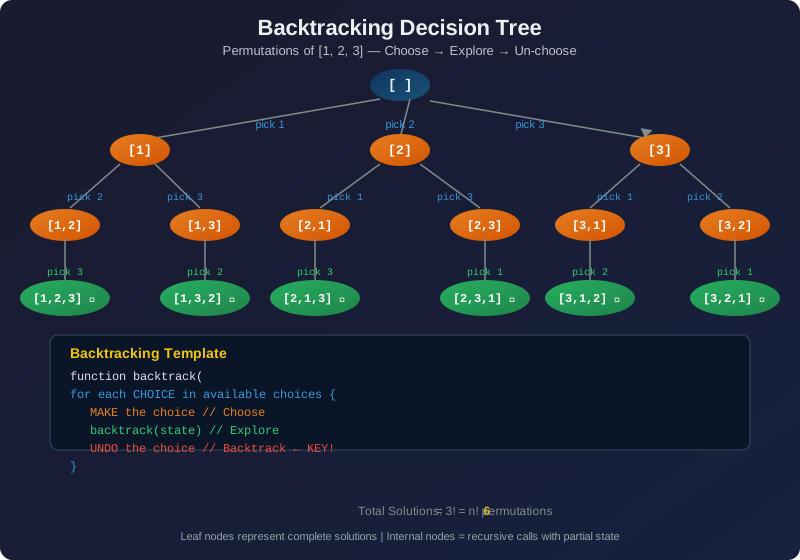
Example: Generate all permutations of [1, 2, 3]
Section titled “Example: Generate all permutations of [1, 2, 3]” [] / | \ pick 1 pick 2 pick 3 [1] [2] [3] / \ / \ / \ pick 2 pick 3 pick 1 pick 3 pick 1 pick 2 [1,2] [1,3] [2,1] [2,3] [3,1] [3,2] | | | | | | pick 3 pick 2 pick 3 pick 1 pick 2 pick 1 [1,2,3] [1,3,2] [2,1,3] [2,3,1] [3,1,2] [3,2,1] ✅ ✅ ✅ ✅ ✅ ✅
6 leaf nodes = 3! = 6 permutationsThe Universal Backtracking Template
Section titled “The Universal Backtracking Template”┌─────────────────────────────────────────────────────┐│ THE BACKTRACKING TEMPLATE ││ ││ function backtrack(state) { ││ if (state is a solution) { ││ record/print the solution ││ return ││ } ││ ││ for each CHOICE in available choices { ││ if (choice is VALID) { ← PRUNING ││ MAKE the choice ← CHOOSE ││ backtrack(updated state) ← EXPLORE ││ UNDO the choice ← BACKTRACK ││ } ││ } ││ } │└─────────────────────────────────────────────────────┘function backtrack(state) { // ===== BASE CASE ===== if (isComplete(state)) { results.push(copy(state)); return; }
// ===== TRY ALL CHOICES ===== for (const choice of getChoices(state)) {
// ===== PRUNING ===== if (!isValid(choice, state)) continue;
// ===== CHOOSE ===== applyChoice(state, choice);
// ===== EXPLORE ===== backtrack(state);
// ===== UN-CHOOSE ===== undoChoice(state, choice); }}State Management
Section titled “State Management”State is the data that represents the “current situation” in your exploration.
| Problem | State | Choices |
|---|---|---|
| Permutations | Current permutation + used flags | Which unused element to add next |
| N-Queens | Board + columns/diags occupied | Which column to place queen in current row |
| Sudoku | The board | Which digit (1-9) to place in current cell |
| Subsets | Current subset + index | Pick or skip current element |
| Combination Sum | Current combination + remaining target | Which candidate to add |
Critical Rule: After recursive exploration, the state MUST be restored exactly as it was before.
// WRONG — state is not restoredcurrent.push(item);backtrack(next);// Missing: current.pop()  ← BUG! State leaks into next iteration.
// CORRECT — state is properly restoredcurrent.push(item);    // Modify statebacktrack(next);       // Explorecurrent.pop();         // Restore state ← ESSENTIAL
Pruning (Optimization)
Section titled “Pruning (Optimization)”Pruning means cutting off branches of the decision tree that we KNOW cannot lead to valid solutions.
WITHOUT PRUNING WITH PRUNING root root / | \ / | \ A B C A B ✗ C (pruned!) /|\ /|\ /|\ /|\ /|\ ... ... ... ... ...Examples of pruning:
Section titled “Examples of pruning:”// 1. Combination Sum: Skip if remaining sum goes negativeif (remaining < 0) return;
// 2. N-Queens: Skip if column or diagonal is attackedif (cols.has(col) || diag1.has(row - col) || diag2.has(row + col)) { continue;}
// 3. Subsets with target sum (positive numbers only)if (currentSum > target) return;
// 4. Sorted candidates: Break earlyif (candidates[i] > remaining) break; // Not continue, BREAK!Next: Backtracking Patterns →