
Classes and Objects
Classes and Objects
Section titled “Classes and Objects”Introduction
Section titled “Introduction”A class is a blueprint for creating objects. An object is an instance of a class. Python is an object-oriented language — everything is an object!
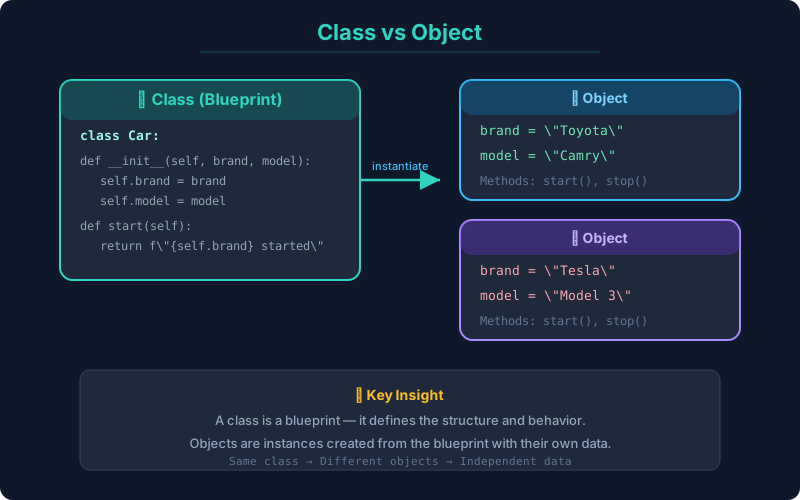
Defining a Class
Section titled “Defining a Class”class Dog: """A simple Dog class."""
# Class attribute — shared by all instances species = "Canis familiaris"
def __init__(self, name, age): """Constructor — called when creating a new Dog.""" self.name = name # Instance attribute self.age = age
def bark(self): """Instance method.""" return f"{self.name} says Woof!"
# Creating objectsmy_dog = Dog("Max", 3)your_dog = Dog("Bella", 5)
print(my_dog.name) # Maxprint(my_dog.bark()) # Max says Woof!print(Dog.species) # Canis familiarisprint(my_dog.species) # Canis familiarisConstructor (__init__)
Section titled “Constructor (__init__)”class Person: def __init__(self, name, age, email=None): self.name = name self.age = age self.email = email self.created_at = datetime.now()Instance Methods
Section titled “Instance Methods”class Counter: def __init__(self): self.count = 0
def increment(self, amount=1): self.count += amount
def decrement(self, amount=1): self.count -= amount
def reset(self): self.count = 0
c = Counter()c.increment(5)c.increment(3)print(c.count) # 8Class Methods and Static Methods
Section titled “Class Methods and Static Methods”class Date: def __init__(self, year, month, day): self.year = year self.month = month self.day = day
@classmethod def from_string(cls, date_string): """Alternative constructor — creates Date from 'YYYY-MM-DD'.""" year, month, day = map(int, date_string.split('-')) return cls(year, month, day)
@classmethod def today(cls): """Alternative constructor — creates Date for today.""" from datetime import date today = date.today() return cls(today.year, today.month, today.day)
@staticmethod def is_valid_date(year, month, day): """Utility method — checks if date is valid.""" try: from datetime import date date(year, month, day) return True except ValueError: return False
d1 = Date(2024, 1, 15)d2 = Date.from_string("2024-06-20")d3 = Date.today()print(Date.is_valid_date(2024, 2, 30)) # FalseDunder Methods
Section titled “Dunder Methods”class Point: def __init__(self, x, y): self.x = x self.y = y
def __str__(self): """String representation for users.""" return f"({self.x}, {self.y})"
def __repr__(self): """String representation for developers.""" return f"Point({self.x!r}, {self.y!r})"
def __eq__(self, other): return self.x == other.x and self.y == other.y
def __add__(self, other): return Point(self.x + other.x, self.y + other.y)
def __len__(self): return int((self.x ** 2 + self.y ** 2) ** 0.5)
p1 = Point(3, 4)p2 = Point(3, 4)print(p1) # (3, 4)print(repr(p1)) # Point(3, 4)print(p1 == p2) # Trueprint(p1 + Point(1, 2)) # (4, 6)print(len(p1)) # 5Best Practices
Section titled “Best Practices”- Use classes to model real-world entities and behaviors
- Keep class focused — single responsibility principle
- Use
@classmethodfor alternative constructors - Use
@staticmethodfor utility functions related to the class - Implement
__str__and__repr__for better debugging
Practice Exercises
Section titled “Practice Exercises”Exercise 1: Create a BankAccount class with deposit, withdraw, and balance methods.
Exercise 2: Create a Library class that manages a collection of Book objects.