Block Scope & Shadowing in JS
Episode 9 : Block Scope & Shadowing in JS
Section titled “Episode 9 : Block Scope & Shadowing in JS”What is a Block?
- Block aka compound statement is used to group JS statements together into 1 group. We group them within {…}
{ var a = 10; let b = 20; const c = 30; // Here let and const are hoisted in Block scope, // While, var is hoisted in Global scope.}- Block Scope and its accessibility example
{ var a = 10; let b = 20; const c = 30;}console.log(a); // 10console.log(b); // Uncaught ReferenceError: b is not defined* Reason? * In the BLOCK SCOPE; we get b and c inside it initialized as *undefined* as a part of hoisting (in a seperate memory space called **block**) * While, a is stored inside a GLOBAL scope.
* Thus we say, *let* and *const* are BLOCK SCOPED. They are stored in a separate mem space which is reserved for this block. Also, they can't be accessed outside this block. But var a can be accessed anywhere as it is in global scope. Thus, we can't access them outside the Block.flowchart TB subgraph Global["Global Scope"] GlobalVar["var a = 100(accessible everywhere)"] end
subgraph Block["Block { ... }"] BlockVar["var a = 10(shadows global a -> overwrites it)"] BlockLet["let b = 20(block scoped - separate memory)"] BlockConst["const c = 30(block scoped - separate memory)"] end
GlobalVar -.->|"Shadowed!"| BlockVar
style Global fill:#7c3aed,color:#fff style Block fill:#1e293b,color:#fff style GlobalVar fill:#4f46e5,color:#fff style BlockVar fill:#dc2626,color:#fff style BlockLet fill:#059669,color:#fff style BlockConst fill:#059669,color:#fffWhat is Shadowing?
Section titled “What is Shadowing?”var a = 100;{ var a = 10; // same name as global var let b = 20; const c = 30; console.log(a); // 10 console.log(b); // 20 console.log(c); // 30}console.log(a); // 10, instead of the 100 we were expecting. So block "a" modified val of global "a" as well. In console, only b and c are in block space. a initially is in global space(a = 100), and when a = 10 line is run, a is not created in block space, but replaces 100 with 10 in global space itself.-
So, If one has same named variable outside the block, the variable inside the block shadows the outside variable. This happens only for var
-
Let’s observe the behaviour in case of let and const and understand it’s reason.
let b = 100;{ var a = 10; let b = 20; const c = 30; console.log(b); // 20}console.log(b); // 100, Both b's are in separate spaces (one in Block(20) and one in Script(another arbitrary mem space)(100)). Same is also true for *const* declarations.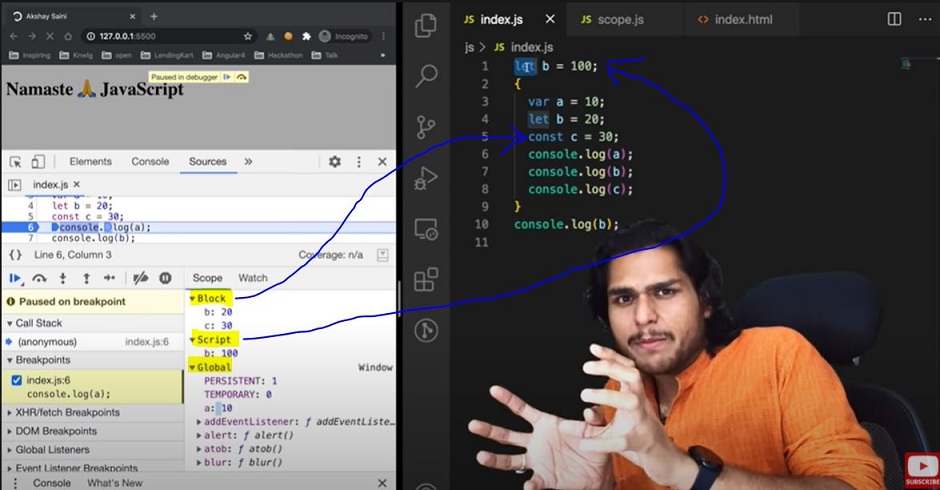
- Same logic is true even for functions
const c = 100;function x() { const c = 10; console.log(c); // 10}x();console.log(c); // 100What is Illegal Shadowing?
let a = 20;{ var a = 20;}// Uncaught SyntaxError: Identifier 'a' has already been declared- We cannot shadow let with var. But it is valid to shadow a let using a let. However, we can shadow var with let.
- All scope rules that work in function are same in arrow functions too.
- Since var is function scoped, it is not a problem with the code below.
let a = 20;function x() { var a = 20;}Watch Live On Youtube below: