
Important Graph Patterns
Important Graph Patterns
Section titled “Important Graph Patterns”These 8 patterns form the foundation of most graph interview problems. Master them to recognize solutions quickly.
Pattern 1: BFS for Shortest Path (Unweighted)
Section titled “Pattern 1: BFS for Shortest Path (Unweighted)”Problem: Find the shortest path from source to target in an unweighted graph.
Key Insight: BFS guarantees the first time we reach a node, it’s via the shortest path.
Graph (unweighted):        BFS from A, find shortest path to F:A - B - D|   |   |                  A(0) → B(1), C(1)C - E - F                  B(1) → D(2), E(2)                           C(1) → E(2)                           D(2) → F(3)  ← first time F reached!
Shortest path: A → B → D → F (length 3)
Template:
function bfsShortestPath(graph, start, end) {  const queue = [[start, [start]]];  // [node, path]  const visited = new Set([start]);
  while (queue.length > 0) {    const [node, path] = queue.shift();    if (node === end) return path;
    for (const neighbor of graph[node] || []) {      if (!visited.has(neighbor)) {        visited.add(neighbor);        queue.push([neighbor, [...path, neighbor]]);      }    }  }  return null;  // No path found}
Pattern 2: DFS for Connected Components / Islands
Section titled “Pattern 2: DFS for Connected Components / Islands”Problem: Count the number of connected components (islands) in a graph or grid.
Key Insight: Each DFS from an unvisited node explores one complete component.
Grid (Number of Islands):1 1 0 0 01 1 0 0 0 Islands found: 30 0 1 0 00 0 0 1 1Template:
function countComponents(grid) {  let count = 0;
  function dfs(r, c) {    if (r < 0 || r >= grid.length || c < 0 || c >= grid[0].length) return;    if (grid[r][c] !== 1) return;    grid[r][c] = 0;  // Mark visited by modifying grid    dfs(r + 1, c); dfs(r - 1, c);    dfs(r, c + 1); dfs(r, c - 1);  }
  for (let r = 0; r < grid.length; r++) {    for (let c = 0; c < grid[0].length; c++) {      if (grid[r][c] === 1) {        dfs(r, c);        count++;      }    }  }  return count;}
Pattern 3: Cycle Detection
Section titled “Pattern 3: Cycle Detection”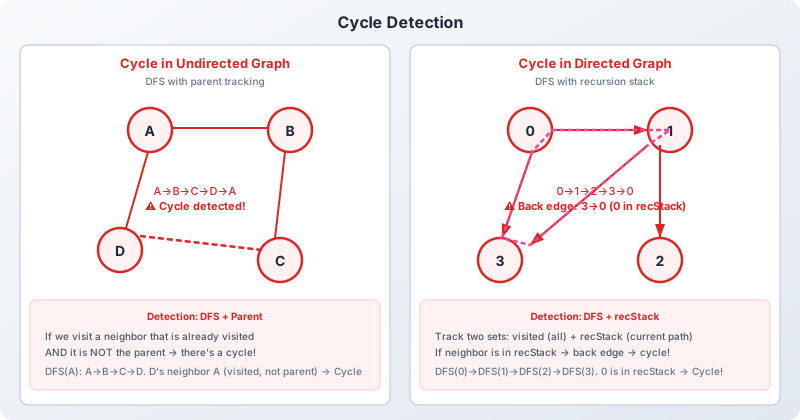
In Undirected Graphs (DFS + Parent Tracking)
Section titled “In Undirected Graphs (DFS + Parent Tracking)”Key Insight: If we visit a node that is already visited AND it’s not the parent of the current node, there’s a cycle.
Has cycle:              No cycle (tree):  0 --- 1                 0 --- 1  |     |                 |     |  3 --- 2                 3     2
DFS from 0: 0→1→2→3→0 (0 already visited, not parent)→ Cycle detected!
function hasCycleUndirected(graph, numNodes) { const visited = new Set();
function dfs(node, parent) { visited.add(node); for (const neighbor of graph[node] || []) { if (!visited.has(neighbor)) { if (dfs(neighbor, node)) return true; } else if (neighbor !== parent) { return true; // Cycle: visited neighbor is not parent } } return false; }
for (let i = 0; i < numNodes; i++) { if (!visited.has(i)) { if (dfs(i, -1)) return true; } } return false;}In Directed Graphs (DFS + Recursion Stack)
Section titled “In Directed Graphs (DFS + Recursion Stack)”Key Insight: Track both visited (globally) and recStack (current DFS path). If we visit a node that’s in recStack, there’s a cycle.
Has cycle:             No cycle (DAG):  0 → 1                 0 → 1  ↑   ↓                 ↓   ↓  3 ← 2                 2   3
recStack during DFS: {0, 1, 2, 3}3 → 0: 0 is in recStack → Back edge → Cycle!
function hasCycleDirected(graph, numNodes) { const visited = new Set(); const recStack = new Set();
function dfs(node) { visited.add(node); recStack.add(node); for (const neighbor of graph[node] || []) { if (!visited.has(neighbor)) { if (dfs(neighbor)) return true; } else if (recStack.has(neighbor)) { return true; // Back edge → cycle! } } recStack.delete(node); return false; }
for (let i = 0; i < numNodes; i++) { if (!visited.has(i)) { if (dfs(i)) return true; } } return false;}Pattern 4: Topological Sort
Section titled “Pattern 4: Topological Sort”Topological Sort orders vertices in a DAG such that for every edge u→v, u comes before v.
Use cases: Task scheduling, build systems, course prerequisites
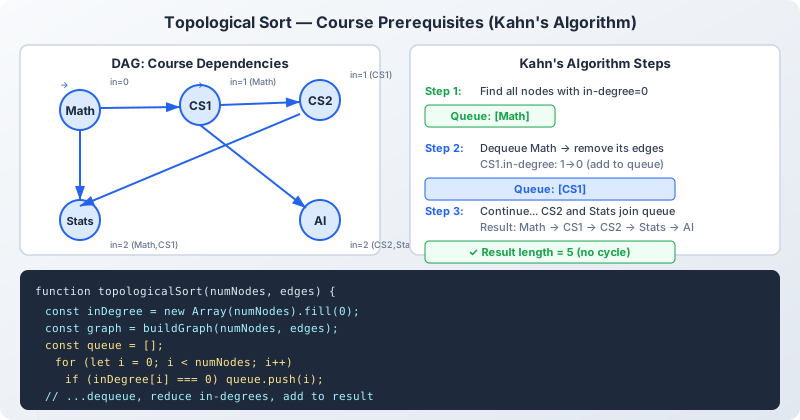
Kahn’s Algorithm (BFS-based)
Section titled “Kahn’s Algorithm (BFS-based)”1. Compute in-degree for all vertices2. Add all 0 in-degree vertices to queue3. Dequeue vertex → add to result → reduce neighbor in-degrees4. If neighbor's in-degree becomes 0, enqueue it5. If result length < V, cycle existsfunction topologicalSort(numNodes, edges) { const graph = Array.from({ length: numNodes }, () => []); const inDegree = new Array(numNodes).fill(0);
for (const [u, v] of edges) { graph[u].push(v); inDegree[v]++; }
const queue = []; for (let i = 0; i < numNodes; i++) { if (inDegree[i] === 0) queue.push(i); }
const result = []; while (queue.length > 0) { const node = queue.shift(); result.push(node); for (const neighbor of graph[node]) { inDegree[neighbor]--; if (inDegree[neighbor] === 0) queue.push(neighbor); } }
return result.length === numNodes ? result : null; // null = cycle}DFS-based Topological Sort
Section titled “DFS-based Topological Sort”1. Do DFS on all unvisited nodes2. After ALL neighbors of a node are processed, push node to stack3. Final result = reverse of stack (post-order + reverse)Pattern 5: Shortest Path Algorithms — Overview
Section titled “Pattern 5: Shortest Path Algorithms — Overview”| Algorithm | Graph Type | Handles Negative? | Complexity | Best For |
|---|---|---|---|---|
| BFS | Unweighted | N/A | O(V + E) | Simple shortest path |
| Dijkstra | Weighted | No | O((V+E) log V) | GPS, network routing |
| Bellman-Ford | Weighted | Yes | O(V × E) | Negative weight detection |
| Floyd-Warshall | All pairs | Yes (no neg cycles) | O(V³) | All-pairs shortest path |
Pattern 6: Union-Find (Disjoint Set Union)
Section titled “Pattern 6: Union-Find (Disjoint Set Union)”Efficiently tracks which elements belong to the same connected component.
Operations:
find(x): Which component does x belong to?union(x, y): Merge the components of x and y
Initial:  {0} {1} {2} {3} {4}
union(0,1): {0,1} {2} {3} {4}union(2,3): {0,1} {2,3} {4}union(0,3): {0,1,2,3} {4}
find(1) === find(2)?  → Yes! (same component)find(1) === find(4)?  → No!  (different component)
Key Optimizations:
- Path Compression:
find(x)flattens the tree → O(α(N)) amortized - Union by Rank: Always attach smaller tree under larger → keeps tree flat
💡 Interview Tip: Union-Find is ideal for dynamic connectivity problems (connecting nodes over time, checking if path exists).
Pattern 7: Bipartite Graph Check
Section titled “Pattern 7: Bipartite Graph Check”A graph is bipartite if its vertices can be colored with 2 colors such that no two adjacent vertices share the same color. Equivalently, it contains no odd-length cycles.
Bipartite:              NOT Bipartite:  R - B - R               R - B  |       |               |\ |  B - R - B               B  R
(R=Red, B=Blue)        Triangle: R-B-R-R? Can't 2-color!
Algorithm: BFS/DFS with 2-coloring. If we ever try to assign the same color to two adjacent nodes, the graph is not bipartite.
function isBipartite(graph, numNodes) {  const color = new Array(numNodes).fill(-1);  // -1=uncolored, 0/1=colors
  for (let start = 0; start < numNodes; start++) {    if (color[start] === -1) {      color[start] = 0;      const queue = [start];
      while (queue.length > 0) {        const node = queue.shift();        for (const neighbor of graph[node] || []) {          if (color[neighbor] === -1) {            color[neighbor] = 1 - color[node];            queue.push(neighbor);          } else if (color[neighbor] === color[node]) {            return false;  // Same color → not bipartite!          }        }      }    }  }  return true;}
Pattern 8: Multi-Source BFS
Section titled “Pattern 8: Multi-Source BFS”Start BFS from multiple sources simultaneously. Used when you need the minimum distance from ANY of several source nodes.
Problem: "Rotting Oranges" — Find minimum time until all oranges are rotten.Grid: Solution: Add ALL rotten oranges (2s) to queue at time 0, then BFS! 2 1 1 1 1 0 Time 0: Queue = [(0,0), ...] (all initial rotten) 0 1 1 Time 1: Spread to all fresh neighborsTemplate:
function multiSourceBFS(grid) {  const rows = grid.length, cols = grid[0].length;  const queue = [];  let fresh = 0;
  // Initialize: add all sources to queue  for (let r = 0; r < rows; r++) {    for (let c = 0; c < cols; c++) {      if (grid[r][c] === 2) queue.push([r, c, 0]);  // [row, col, time]      else if (grid[r][c] === 1) fresh++;    }  }
  if (fresh === 0) return 0;
  const dirs = [[0,1],[0,-1],[1,0],[-1,0]];  let maxTime = 0;
  while (queue.length > 0) {    const [r, c, time] = queue.shift();    maxTime = Math.max(maxTime, time);
    for (const [dr, dc] of dirs) {      const nr = r + dr, nc = c + dc;      if (nr >= 0 && nr < rows && nc >= 0 && nc < cols && grid[nr][nc] === 1) {        grid[nr][nc] = 2;   // Rotten!        fresh--;        queue.push([nr, nc, time + 1]);      }    }  }
  return fresh === 0 ? maxTime : -1;  // -1 = some oranges never rot}
Pattern Cheat Sheet
Section titled “Pattern Cheat Sheet”| Pattern | Technique | Key Data Structure | When to Use |
|---|---|---|---|
| Shortest Path | BFS | Queue | Unweighted graphs, minimum steps |
| Connected Components | DFS / BFS loop | Visited Set | Island counting, group detection |
| Cycle Detection | DFS + tracking | Parent / recStack | Deadlock detection, valid tree |
| Topological Sort | Kahn’s / DFS | Queue / Stack | Task ordering, prerequisites |
| Union-Find | DSU | Parent + Rank arrays | Dynamic connectivity, MST |
| Bipartite Check | 2-coloring | Color array | Odd cycle detection, matching |
| Multi-Source BFS | Level BFS | Queue with time | Rotting oranges, 01 matrix |
Next Steps
Section titled “Next Steps”Now explore the Key Graph Algorithms — Dijkstra, Bellman-Ford, Kruskal, and Prim.
Related Topics
Section titled “Related Topics”- Tree Patterns — Compare tree patterns with graph patterns
- Recursion — DFS relies heavily on recursion