
Two Pointer Technique
Two Pointer Technique
Section titled “Two Pointer Technique”Overview
Section titled “Overview”The Two Pointer technique uses two pointers (index variables) to traverse an array, typically moving toward each other or in the same direction at different speeds. It reduces time complexity from O(n²) to O(n) in many cases.
Common Patterns
Section titled “Common Patterns”1. Pointer Moving Toward Each Other
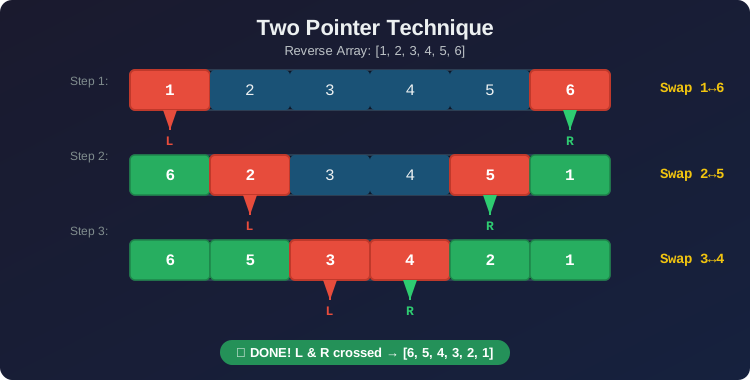
Section titled “1. Pointer Moving Toward Each Other”Use Cases: Reverse array, palindrome check, two-sum in sorted array
/** * Reverse array in-place * Left pointer starts at 0, right pointer at end. * Swap, then move L→, R← until they meet. */function reverseArray(arr) {    let left = 0;    let right = arr.length - 1;
    while (left < right) {        // Swap        [arr[left], arr[right]] = [arr[right], arr[left]];        left++;        right--;    }
    return arr;}
console.log(reverseArray([1, 2, 3, 4, 5])); // [5, 4, 3, 2, 1]
/** * Check if a string is a palindrome * Compare characters at left and right, moving inward. */function isPalindrome(str) { let left = 0; let right = str.length - 1;
while (left < right) { if (str[left] !== str[right]) return false; left++; right--; }
return true;}
console.log(isPalindrome("racecar")); // trueconsole.log(isPalindrome("hello")); // false/** * Two Sum in SORTED array * Since array is sorted, if sum > target, move right pointer left. * If sum < target, move left pointer right. */function twoSumSorted(nums, target) { let left = 0; let right = nums.length - 1;
while (left < right) { const sum = nums[left] + nums[right];
if (sum === target) return [left, right]; if (sum < target) left++; else right--; }
return [-1, -1];}
console.log(twoSumSorted([2, 7, 11, 15], 9)); // [0, 1]2. Fast and Slow Pointer
Section titled “2. Fast and Slow Pointer”Use Cases: Cycle detection, middle of linked list
/** * Find middle of an array * Fast pointer moves 2 steps, slow moves 1 step. * When fast reaches end, slow is at the middle. */function findMiddle(arr) {    let slow = 0;    let fast = 0;
    while (fast < arr.length && fast + 1 < arr.length) {        slow++;        fast += 2;    }
    return arr[slow];}
console.log(findMiddle([1, 2, 3, 4, 5]));    // 3console.log(findMiddle([1, 2, 3, 4, 5, 6])); // 4
3. Same Direction Pointers (Sliding Window Variation)
Section titled “3. Same Direction Pointers (Sliding Window Variation)”Use Cases: Removing duplicates from sorted array, in-place array operations
/** * Remove duplicates from sorted array in-place * Slow pointer tracks unique elements position. * Fast pointer scans ahead for new values. */function removeDuplicates(nums) {    if (nums.length === 0) return 0;
    let slow = 0;
    for (let fast = 1; fast < nums.length; fast++) {        if (nums[fast] !== nums[slow]) {            slow++;            nums[slow] = nums[fast];        }    }
    return slow + 1; // length of unique portion}
console.log(removeDuplicates([1, 1, 2, 2, 3, 4, 4, 5]));// Returns 5, array becomes [1, 2, 3, 4, 5, ...]
When to Use Two Pointers
Section titled “When to Use Two Pointers”| Signal | Pattern | Example Problems |
|---|---|---|
| Sorted array | Pointers toward each other | Two Sum II, Three Sum |
| Palindrome | Start and end compare | Valid Palindrome |
| In-place reverse | Swap ends | Reverse array/string |
| Remove duplicates | Slow/fast same direction | Remove Duplicates |
| Find middle | Fast/slow | Middle of Linked List |
| Container area | Maximize area | Container With Most Water |
| Triplet sum | Fix one, two-point rest | Three Sum |
Time Complexity Analysis
Section titled “Time Complexity Analysis”| Problem | Brute Force | Two Pointer |
|---|---|---|
| Two Sum (sorted) | O(n²) | O(n) |
| Three Sum | O(n³) | O(n²) |
| Palindrome Check | O(n²) | O(n) |
| Remove Duplicates | O(n²) | O(n) |
| Reverse Array | O(n) | O(n) — but O(1) extra space |
Next: Sliding Window →