
Selection Sort
Selection Sort
Section titled “Selection Sort”🎯 What Is Selection Sort?
Section titled “🎯 What Is Selection Sort?”Selection Sort works by repeatedly finding the minimum element from the unsorted portion and placing it at the beginning of the unsorted section.
Core idea: Divide the array into a sorted portion (left) and an unsorted portion (right). In each pass, select the minimum from the unsorted portion and swap it to its correct position.
🔹 How It Works — Step by Step
Section titled “🔹 How It Works — Step by Step”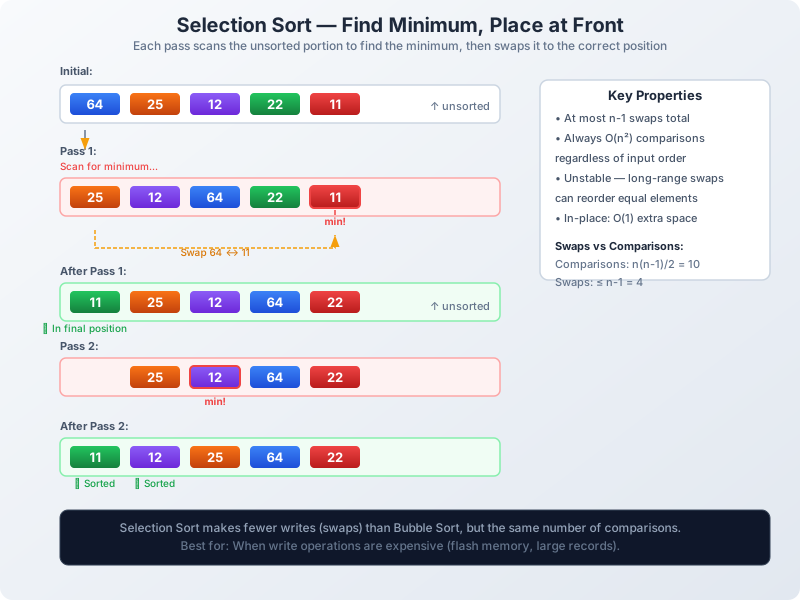
Visual Walkthrough
Section titled “Visual Walkthrough”Sort: [64, 25, 12, 22, 11]
Initial state:[64, 25, 12, 22, 11] ↑ sorted boundary
─────────────────────────────────────────Pass 1: Find minimum in entire array─────────────────────────────────────────[64, 25, 12, 22, 11] ↑                ↑ i=0          min=11 (at index 4)
Swap index 0 with index 4:[11, 25, 12, 22, 64] ✅  ←── unsorted ───→
─────────────────────────────────────────Pass 2: Find minimum in [25, 12, 22, 64]─────────────────────────────────────────[11, 25, 12, 22, 64]     ↑   ↑    i=1  min=12 (at index 2)
Swap index 1 with index 2:[11, 12, 25, 22, 64] ✅  ✅  ←── unsorted ──→
─────────────────────────────────────────Pass 3: Find minimum in [25, 22, 64]─────────────────────────────────────────[11, 12, 25, 22, 64]         ↑   ↑        i=2  min=22 (at index 3)
Swap index 2 with index 3:[11, 12, 22, 25, 64] ✅  ✅  ✅  ←── unsorted →
─────────────────────────────────────────Pass 4: Find minimum in [25, 64]─────────────────────────────────────────[11, 12, 22, 25, 64]             ↑   ↑            i=3  min=25 (already in place)
No swap needed (min is already at i):[11, 12, 22, 25, 64] ✅  ✅  ✅  ✅  ✅
Final sorted: [11, 12, 22, 25, 64] ✅
Key Observation
Section titled “Key Observation”Selection Sort makes at most n-1 swaps — one per pass. This is significantly fewer than Bubble Sort which can make O(n²) swaps. This matters when swaps are expensive (e.g., writing to disk or flash memory).
🔹 JavaScript Implementation
Section titled “🔹 JavaScript Implementation”function selectionSort(arr) { const n = arr.length;
for (let i = 0; i < n - 1; i++) { // Assume the current position holds the minimum let minIndex = i;
// Find the actual minimum in the unsorted portion for (let j = i + 1; j < n; j++) { if (arr[j] < arr[minIndex]) { minIndex = j; // Update minimum index } }
// Only swap if the minimum is not already in position if (minIndex !== i) { [arr[i], arr[minIndex]] = [arr[minIndex], arr[i]]; } }
return arr;}
// Testconsole.log(selectionSort([64, 25, 12, 22, 11]));// Output: [11, 12, 22, 25, 64]
console.log(selectionSort([5, 3, 1, 4, 2]));// Output: [1, 2, 3, 4, 5]🔹 Descending Order
Section titled “🔹 Descending Order”function selectionSortDescending(arr) { const n = arr.length;
for (let i = 0; i < n - 1; i++) { let maxIndex = i; // ← Find MAX instead of min
for (let j = i + 1; j < n; j++) { if (arr[j] > arr[maxIndex]) { // ← Compare with > maxIndex = j; } }
if (maxIndex !== i) { [arr[i], arr[maxIndex]] = [arr[maxIndex], arr[i]]; } }
return arr;}
console.log(selectionSortDescending([64, 25, 12, 22, 11]));// Output: [64, 25, 22, 12, 11]🔹 Sorting Objects
Section titled “🔹 Sorting Objects”function selectionSortByKey(arr, key) { const n = arr.length;
for (let i = 0; i < n - 1; i++) { let minIndex = i;
for (let j = i + 1; j < n; j++) { if (arr[j][key] < arr[minIndex][key]) { minIndex = j; } }
if (minIndex !== i) { [arr[i], arr[minIndex]] = [arr[minIndex], arr[i]]; } }
return arr;}
const players = [ { name: 'Alice', score: 85 }, { name: 'Bob', score: 92 }, { name: 'Carol', score: 78 }, { name: 'Dave', score: 95 }];
console.log(selectionSortByKey(players, 'score'));// Sorted by score ascending:// [{Carol,78}, {Alice,85}, {Bob,92}, {Dave,95}]🔹 Counting Swaps (Selection Sort Advantage)
Section titled “🔹 Counting Swaps (Selection Sort Advantage)”function selectionSortCountSwaps(arr) { const n = arr.length; let swapCount = 0;
for (let i = 0; i < n - 1; i++) { let minIndex = i;
for (let j = i + 1; j < n; j++) { if (arr[j] < arr[minIndex]) { minIndex = j; } }
if (minIndex !== i) { [arr[i], arr[minIndex]] = [arr[minIndex], arr[i]]; swapCount++; } }
console.log(`Total swaps: ${swapCount}`); // Always ≤ n-1 return arr;}
selectionSortCountSwaps([64, 25, 12, 22, 11]);// Total swaps: 4 (at most n-1 = 4)
// Compare with Bubble Sort on same input:// Bubble Sort would make: 10 swaps!📊 Time & Space Complexity
Section titled “📊 Time & Space Complexity”| Case | Time Complexity | Explanation |
|---|---|---|
| Best Case | O(n²) | Still scans the entire unsorted portion even if sorted |
| Average Case | O(n²) | Always makes n(n-1)/2 comparisons |
| Worst Case | O(n²) | No difference from best case |
| Space | O(1) | In-place — only uses index variables |
Why Always O(n²)?
Section titled “Why Always O(n²)?”Unlike Bubble Sort, Selection Sort has no early exit mechanism. Even if the array is already sorted, it must scan the entire unsorted portion to confirm the minimum:
Pass 1: Scans n-1 elements to find minimumPass 2: Scans n-2 elements to find minimumPass 3: Scans n-3 elements to find minimum...Pass n-1: Scans 1 element
Total comparisons = (n-1) + (n-2) + ... + 1 = n(n-1)/2 = O(n²)Always. No exceptions.
🔹 Is Selection Sort Stable?
Section titled “🔹 Is Selection Sort Stable?”No — Selection Sort is unstable.
When the minimum element is swapped to the front, it can jump over equal elements, disturbing their relative order.
Example:Original: [(3,a), (3,b), (1,c)]           Equal values: 3a and 3b (a should come before b)
Pass 1: Find minimum → (1,c) at index 2        Swap index 0 with index 2:        [(1,c), (3,b), (3,a)]                       ↑                 3a is now AFTER 3b ← original order destroyed ❌
Interview tip: This is the key difference from Bubble Sort. Selection Sort’s long-range swaps break stability, while Bubble Sort’s adjacent swaps preserve it.
🔹 Selection Sort vs Bubble Sort
Section titled “🔹 Selection Sort vs Bubble Sort”| Property | Selection Sort | Bubble Sort |
|---|---|---|
| Time (Best) | O(n²) | O(n) with optimization |
| Time (Average) | O(n²) | O(n²) |
| Time (Worst) | O(n²) | O(n²) |
| Space | O(1) | O(1) |
| Stable | ❌ No | ✅ Yes |
| Number of Swaps | At most n-1 | Up to O(n²) |
| Number of Comparisons | Always n(n-1)/2 | Varies |
| Adaptive | ❌ No | ✅ Yes (with optimization) |
When Selection Sort Beats Bubble Sort
Section titled “When Selection Sort Beats Bubble Sort”Selection Sort is preferable when write operations (swaps) are expensive and comparisons are cheap:
- Writing to flash memory (limited write cycles)
- Writing to disk storage (I/O bound)
- Swapping large records in memory
// Selection Sort: O(n) writes (one swap per pass)// Bubble Sort:   O(n²) writes (many swaps per pass)
// For n = 1000:// Selection Sort: ~1000 swaps// Bubble Sort:    up to ~500,000 swaps
🔹 Properties Summary
Section titled “🔹 Properties Summary”| Property | Value |
|---|---|
| Time (Best) | O(n²) |
| Time (Average) | O(n²) |
| Time (Worst) | O(n²) |
| Space | O(1) |
| Stable | ❌ No |
| In-Place | ✅ Yes |
| Adaptive | ❌ No |
| Writes/Swaps | O(n) — at most n-1 |
🎯 When to Use Selection Sort
Section titled “🎯 When to Use Selection Sort”Use Selection Sort When:
Section titled “Use Selection Sort When:”- Write operations are costly (flash memory, disk I/O)
- Memory is extremely limited (O(1) space, no optimization overhead)
- The dataset is small and simplicity is preferred over efficiency
- You need to find and place k smallest elements (run only k passes)
Do NOT Use When:
Section titled “Do NOT Use When:”- Input is large (O(n²) is too slow)
- Stability is required
- Input is nearly sorted (Insertion Sort would be far faster)
💡 Interview Tips
Section titled “💡 Interview Tips”“Is Selection Sort ever better than Bubble Sort?” — Yes. Selection Sort makes at most n-1 swaps vs O(n²) swaps for Bubble Sort. When swaps are expensive, Selection Sort wins.
“Why is Selection Sort not adaptive?” — It always scans the entire unsorted portion regardless of input order. There’s no equivalent of Bubble Sort’s
swappedflag.
“Is Selection Sort stable?” — No. The long-range swap (swapping the found minimum with position i) can displace equal elements, breaking relative order.
“What is Selection Sort’s best case?” — Still O(n²) comparisons. It’s always O(n²) — the only variation is the number of swaps (up to n-1).
Next: Insertion Sort →