
Bubble Sort
Bubble Sort
Section titled “Bubble Sort”🎯 What Is Bubble Sort?
Section titled “🎯 What Is Bubble Sort?”Bubble Sort is the simplest sorting algorithm. It works by repeatedly comparing adjacent elements and swapping them if they are in the wrong order. Larger elements “bubble up” to the end of the array with each pass.
Name origin: Larger elements “bubble up” to the top (end) of the array, just like air bubbles rise to the surface of water.
🔹 How It Works — Step by Step
Section titled “🔹 How It Works — Step by Step”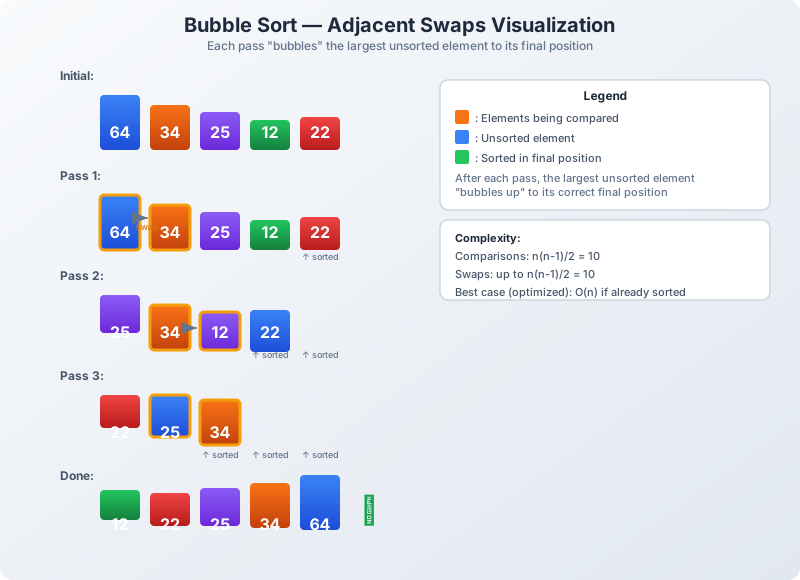
Visual Example
Section titled “Visual Example”Sort: [64, 34, 25, 12, 22]
Pass 1: Compare and swap adjacent pairs─────────────────────────────────────────[64, 34, 25, 12, 22] ↑   ↑ 64 > 34 → SWAP[34, 64, 25, 12, 22]     ↑   ↑     64 > 25 → SWAP[34, 25, 64, 12, 22]         ↑   ↑         64 > 12 → SWAP[34, 25, 12, 64, 22]             ↑   ↑             64 > 22 → SWAP[34, 25, 12, 22, 64]  ← 64 is now in final position ✅
Pass 2:[34, 25, 12, 22, 64] ↑   ↑ 34 > 25 → SWAP[25, 34, 12, 22, 64]     ↑   ↑     34 > 12 → SWAP[25, 12, 34, 22, 64]         ↑   ↑         34 > 22 → SWAP[25, 12, 22, 34, 64]  ← 34 is now in final position ✅
Pass 3:[25, 12, 22, 34, 64] ↑   ↑ 25 > 12 → SWAP[12, 25, 22, 34, 64]     ↑   ↑     25 > 22 → SWAP[12, 22, 25, 34, 64]  ← 25 is now in final position ✅
Pass 4:[12, 22, 25, 34, 64] ↑   ↑ 12 < 22 → no swap[12, 22, 25, 34, 64]  ← 22 is now in final position ✅
Final sorted: [12, 22, 25, 34, 64] ✅
Key Observation
Section titled “Key Observation”After each pass i, the last i elements are in their correct final positions and never need to be touched again.
After Pass 1: [__, __, __, __, 64] ← last 1 sortedAfter Pass 2: [__, __, __, 34, 64] ← last 2 sortedAfter Pass 3: [__, __, 25, 34, 64] ← last 3 sortedAfter Pass 4: [__, 22, 25, 34, 64] ← last 4 sortedAfter Pass 5: [12, 22, 25, 34, 64] ← all sorted ✅🔹 Basic JavaScript Implementation
Section titled “🔹 Basic JavaScript Implementation”function bubbleSort(arr) { const n = arr.length;
for (let i = 0; i < n - 1; i++) { // After pass i, the last i elements are sorted // So inner loop only goes up to n - 1 - i for (let j = 0; j < n - 1 - i; j++) { if (arr[j] > arr[j + 1]) { // Swap adjacent elements let temp = arr[j]; arr[j] = arr[j + 1]; arr[j + 1] = temp; } } }
return arr;}
// Testconsole.log(bubbleSort([64, 34, 25, 12, 22]));// Output: [12, 22, 25, 34, 64]🔹 Optimized Bubble Sort — Early Exit
Section titled “🔹 Optimized Bubble Sort — Early Exit”The basic version always runs n-1 passes even if the array becomes sorted early. The optimized version uses a swapped flag to detect when no swaps occurred in a pass — meaning the array is already sorted.
function bubbleSortOptimized(arr) {    const n = arr.length;
    for (let i = 0; i < n - 1; i++) {        let swapped = false;  // ← Flag to detect early completion
        for (let j = 0; j < n - 1 - i; j++) {            if (arr[j] > arr[j + 1]) {                // Swap                [arr[j], arr[j + 1]] = [arr[j + 1], arr[j]];                swapped = true;  // ← A swap happened this pass            }        }
        // If no swaps occurred, array is already sorted → exit early        if (!swapped) {            console.log(`Sorted early after ${i + 1} pass(es)!`);            break;        }    }
    return arr;}
// Best case demo: already sortedconsole.log(bubbleSortOptimized([1, 2, 3, 4, 5]));// Output: "Sorted early after 1 pass(es)!"//         [1, 2, 3, 4, 5]
// Nearly sorted democonsole.log(bubbleSortOptimized([1, 2, 4, 3, 5]));// Only needs 2 passes instead of 4
Why This Matters
Section titled “Why This Matters”| Input | Basic Version | Optimized Version |
|---|---|---|
Already sorted [1,2,3,4,5] | O(n²) — still runs all passes | O(n) — exits after 1 pass |
Nearly sorted [1,2,4,3,5] | O(n²) | Much faster in practice |
Reverse sorted [5,4,3,2,1] | O(n²) | O(n²) — no improvement |
| Random | O(n²) | O(n²) on average |
🔹 Bubble Sort with Descending Order
Section titled “🔹 Bubble Sort with Descending Order”function bubbleSortDescending(arr) { const n = arr.length;
for (let i = 0; i < n - 1; i++) { let swapped = false;
for (let j = 0; j < n - 1 - i; j++) { if (arr[j] < arr[j + 1]) { // ← Change > to < for descending [arr[j], arr[j + 1]] = [arr[j + 1], arr[j]]; swapped = true; } }
if (!swapped) break; }
return arr;}
console.log(bubbleSortDescending([3, 1, 4, 1, 5, 9, 2, 6]));// Output: [9, 6, 5, 4, 3, 2, 1, 1]🔹 Sorting Objects with Bubble Sort
Section titled “🔹 Sorting Objects with Bubble Sort”function bubbleSortByProperty(arr, key) { const n = arr.length;
for (let i = 0; i < n - 1; i++) { let swapped = false;
for (let j = 0; j < n - 1 - i; j++) { if (arr[j][key] > arr[j + 1][key]) { [arr[j], arr[j + 1]] = [arr[j + 1], arr[j]]; swapped = true; } }
if (!swapped) break; }
return arr;}
const students = [ { name: 'Alice', score: 85 }, { name: 'Bob', score: 72 }, { name: 'Carol', score: 91 }, { name: 'Dave', score: 68 }];
console.log(bubbleSortByProperty(students, 'score'));// Output: sorted by score ascending// [{ name: 'Dave', score: 68 }, { name: 'Bob', score: 72 }, ...]📊 Time & Space Complexity
Section titled “📊 Time & Space Complexity”| Case | Time Complexity | Explanation |
|---|---|---|
| Best Case | O(n) | Already sorted — optimized version exits after 1 pass |
| Average Case | O(n²) | Random input — roughly n²/2 comparisons |
| Worst Case | O(n²) | Reverse sorted — maximum swaps needed |
| Space | O(1) | In-place — only uses a few extra variables |
Why O(n²)?
Section titled “Why O(n²)?”The outer loop runs n-1 times.
The inner loop runs approximately n/2 times on average.
Total comparisons ≈ (n-1) + (n-2) + ... + 1 = n(n-1)/2 = O(n²)Stability
Section titled “Stability”Bubble Sort is stable. When two adjacent elements are equal (arr[j] === arr[j+1]), the condition arr[j] > arr[j+1] is false, so no swap occurs. Equal elements maintain their relative order.
🔹 Properties Summary
Section titled “🔹 Properties Summary”| Property | Value |
|---|---|
| Time (Best) | O(n) |
| Time (Average) | O(n²) |
| Time (Worst) | O(n²) |
| Space | O(1) |
| Stable | ✅ Yes |
| In-Place | ✅ Yes |
| Adaptive | ✅ Yes (with optimization) |
| Online | ❌ No |
🎯 When to Use Bubble Sort
Section titled “🎯 When to Use Bubble Sort”Use Bubble Sort When:
Section titled “Use Bubble Sort When:”- The input is very small (n < 10–20 elements)
- The input is nearly sorted (optimized version shines)
- You need a simple, easy-to-remember algorithm
- Educational purposes — it’s the easiest sort to explain
Do NOT Use Bubble Sort When:
Section titled “Do NOT Use Bubble Sort When:”- The input is large (n > 1000) — O(n²) becomes very slow
- Performance is critical
- Random or reverse-sorted data is expected
Real-World Usage
Section titled “Real-World Usage”Bubble Sort is rarely used in production code. However, it appears in:
- Embedded systems with tiny datasets
- Teaching algorithms in CS courses
- As a baseline to compare against better algorithms
💡 Interview Tips
Section titled “💡 Interview Tips”“Explain Bubble Sort” — Describe adjacent comparisons, bubbling up the largest element each pass. Always mention the early-exit optimization.
“What is Bubble Sort’s best case?” — O(n) with the
swappedflag optimization on an already-sorted array.
“Is Bubble Sort stable?” — Yes. Equal adjacent elements are never swapped, preserving relative order.
“Why is Bubble Sort O(n²)?” — Two nested loops. Outer loop runs n-1 times, inner loop runs up to n-i-1 times → n²/2 total comparisons → O(n²).
Next: Selection Sort →